How to Become a Data Scientist in 2026: Complete Roadmap, Machine Learning & Generative AI Guide
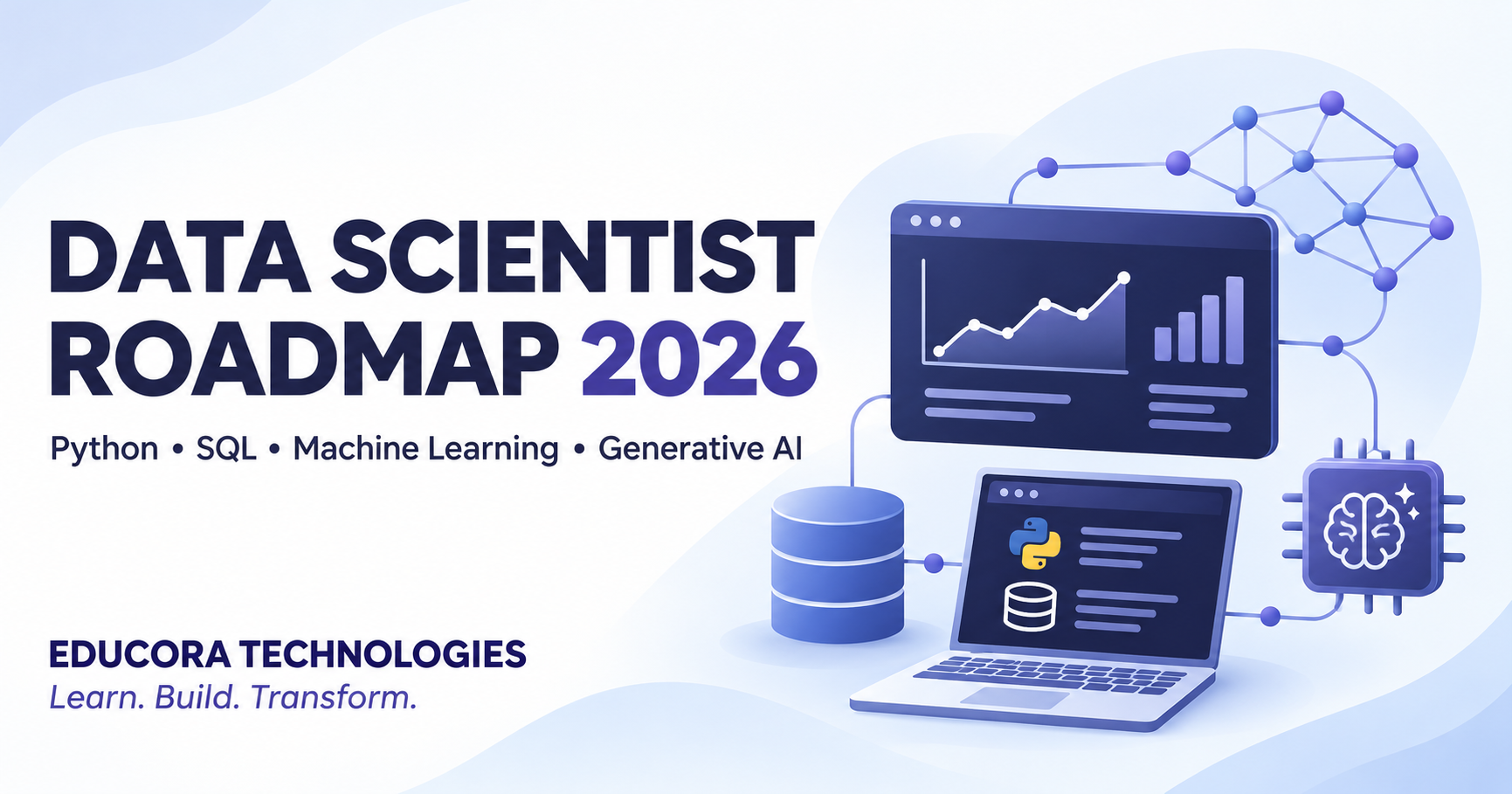
Data Science and Generative Artificial Intelligence are changing how businesses analyze information, predict outcomes and build intelligent applications.
From predicting customer demand and identifying unusual transactions to building AI-powered document assistants, organizations use data and AI to solve practical problems.
But if you’re a student or beginner interested in this field, one question often comes first:
How do I become a Data Scientist, and what should I learn before starting Generative AI?
Should you begin with Python? Do you need advanced mathematics? Is Machine Learning compulsory? Can BCA, BCom or BSc graduates enter this field?
The answer is to follow a structured learning path, understand the fundamentals and develop practical projects.
In this Data Scientist Roadmap for 2026, we’ll explore:
- What Data Science and Generative AI actually mean.
- The differences between Data Analytics, Data Science, Machine Learning and Generative AI.
- Essential programming, mathematics and technical skills.
- An eight-step learning roadmap for beginners.
- Practical Data Science and Generative AI projects.
- Career opportunities for students and graduates in India.
- How structured technical training and practical experience support career preparation.
Let’s begin with the basics.
1. What Is Data Science?
Data Science is an interdisciplinary field that uses programming, mathematics, statistics and analytical methods to extract useful knowledge from data and develop data-driven solutions.
It combines several areas:
- Data collection and preparation.
- Exploratory Data Analysis (EDA).
- Statistics and probability.
- Programming and automation.
- Machine Learning.
- Model evaluation.
- Data visualization.
- Business problem-solving.
A Practical Example
Imagine an e-commerce company wants to identify customers who may stop purchasing its products.
A Data Scientist could:
- Collect historical customer transactions.
- Clean incomplete and inconsistent data.
- Explore purchasing patterns.
- Define a measurable customer-retention problem.
- Develop a predictive Machine Learning model.
- Evaluate its predictions using appropriate metrics.
- Explain model limitations and recommend how the business should use the results.
The goal is not simply to create a prediction.
The goal is to produce information that supports responsible and measurable business decisions.
Data Science combines technical skills with the ability to understand and solve real problems.
2. What Is Generative AI?
Generative Artificial Intelligence, commonly called Generative AI or GenAI, refers to AI systems that can produce new content based on patterns learned during training.
Depending on the model, Generative AI can produce:
- Text and written explanations.
- Programming code.
- Images.
- Summaries of documents.
- Structured information.
- Conversational responses.
- Other supported forms of generated content.
Large Language Models (LLMs) are a major category of Generative AI systems used for language-related tasks.
For example, a company could develop an internal AI assistant that helps authorized employees find information in company policies.
Rather than manually searching multiple documents, an employee could ask a question and receive a generated answer supported by retrieved document passages.
However, Generative AI systems can produce incorrect or unsupported information.
For professional applications, developers should understand privacy, security, testing, output verification and the limitations of AI-generated responses.
Why Should Data Science Students Learn Generative AI?
Data Science provides foundational skills in data preparation, statistics, programming, evaluation and analytical reasoning.
These skills also support work involving AI applications.
For example, someone familiar with Python and data processing can more easily understand how to prepare documents for retrieval, evaluate model responses and test an AI-assisted workflow.
A strong Data Science foundation makes it easier to approach Generative AI as an engineering discipline rather than merely learning prompts.
3. Data Analytics vs Data Science vs Machine Learning vs Generative AI
Beginners sometimes use these terms interchangeably, but they describe related and different areas.
| Field | Primary Focus | Example |
|---|---|---|
| Data Analytics | Understanding data and explaining performance | Why did monthly revenue decrease? |
| Data Science | Developing data-driven analytical and predictive solutions | Which customers are at risk of leaving? |
| Machine Learning | Learning patterns from data to make predictions or decisions | Predicting product demand |
| Generative AI | Generating new content or responses | Building an AI document assistant |
Which Field Should You Choose?
If you enjoy dashboards, business reporting and explaining trends, Data Analytics may be an appropriate starting point.
If you enjoy programming, statistics, experimentation and predictive modeling, Data Science may suit your interests.
If you’re interested in intelligent applications, language models and document-based assistants, Generative AI development may be attractive.
These fields overlap, and you do not need to decide your entire career before learning their foundations.
4. Why Learn Data Science and Generative AI in 2026?
Organizations in different industries use statistical analysis, predictive modeling and AI-enabled applications to support their operations.
Examples include:
| Industry | Data Science Application | Generative AI Application |
|---|---|---|
| Banking | Credit-risk analysis and anomaly detection | Internal document assistants |
| Healthcare | Operational forecasting and research analysis | Summarizing authorized administrative documents |
| Retail | Demand forecasting and customer segmentation | Product-content assistance |
| Manufacturing | Predictive maintenance and quality analysis | Technical knowledge assistance |
| Education | Learning-performance analysis | Guided learning assistants |
| Logistics | Route and demand analysis | Operational documentation support |
| Information Technology | Application analytics and model development | Code and documentation assistants |
These are examples of possible applications, not claims that every organization uses all these technologies.
Although the field provides interesting opportunities, employers assess practical abilities, mathematics, programming, communication and relevant experience.
Learning a few AI tools does not automatically qualify someone for a Data Scientist or AI Engineer position.
5. Complete Data Scientist Roadmap for Beginners in 2026
For someone starting from scratch, the recommended progression is:
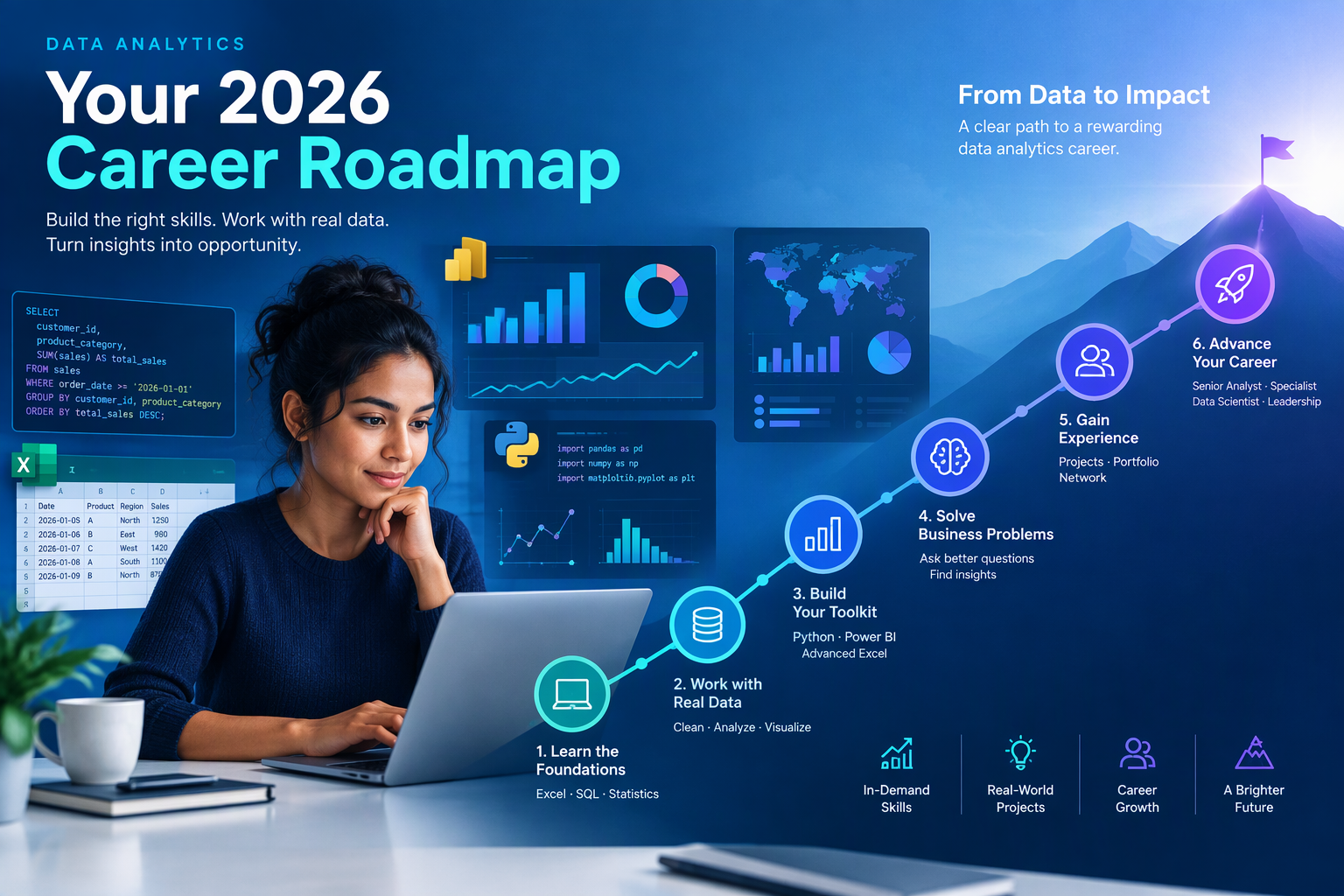
Python → SQL and Data Preparation → Statistics → Exploratory Data Analysis → Machine Learning → Model Evaluation → Generative AI → Projects and Career Preparation
Each stage supports the next.
Step 1: Learn Python Programming
Python is widely used in Data Science because it supports data processing, numerical analysis, Machine Learning and application development.
Begin with:
- Variables and data types.
- Conditional statements.
- Loops.
- Lists, tuples, sets and dictionaries.
- Functions.
- File handling.
- Exceptions.
- Python packages and virtual environments.
- Jupyter Notebook.
- Basic Git and version control.
Practical assignment: Create a Python program that reads a CSV file, checks missing entries and calculates summary statistics.
At this stage, concentrate on understanding code rather than copying complete solutions from AI assistants.
Step 2: Learn SQL and Data Preparation
Data Scientists frequently work with structured information stored in databases.
SQL helps retrieve and combine that information.
Important concepts include:
- SELECT, WHERE and ORDER BY.
- GROUP BY and HAVING.
- Aggregate functions.
- INNER JOIN and LEFT JOIN.
- Subqueries.
- Common Table Expressions.
- Basic window functions.
- Database relationships.
Alongside SQL, learn Python libraries such as Pandas and NumPy.
With Pandas, practise:
- Importing datasets.
- Handling missing values.
- Identifying duplicates.
- Combining datasets.
- Filtering records.
- Grouping and summarizing data.
- Validating data types.
Practical assignment: Retrieve a sales dataset using SQL and prepare it for analysis in Python.
Step 3: Learn Mathematics and Statistics
Statistics helps Data Scientists distinguish meaningful patterns from random variation.
Begin with:
- Mean, median and mode.
- Variance and standard deviation.
- Probability concepts.
- Distributions.
- Sampling.
- Correlation and causation.
- Confidence intervals.
- Hypothesis-testing fundamentals.
- Basic algebra and introductory linear algebra.
You do not need to master advanced mathematics before writing your first Python program.
However, deeper understanding becomes increasingly important as you work with modeling algorithms, optimization and statistical inference.
Practical assignment: Analyze sales performance across multiple regions and explain whether average performance adequately represents each region.
Step 4: Learn Exploratory Data Analysis and Visualization
Exploratory Data Analysis, or EDA, helps you understand a dataset before building predictive models.
Learn how to:
- Examine data distributions.
- Identify unusual values.
- Explore relationships between variables.
- Detect missing or inconsistent records.
- Compare categories and groups.
- Create readable charts.
- Recognize potential data leakage.
Useful visualization libraries include Matplotlib and Seaborn.
Practical assignment: Analyze a retail dataset and produce a short report showing product performance, order patterns and data-quality limitations.
Step 5: Understand Machine Learning Fundamentals
Machine Learning enables systems to learn patterns from examples.
Start with the difference between supervised and unsupervised learning.
Supervised Learning
Used when a dataset contains a target value or category.
Examples include:
- Predicting house prices.
- Estimating sales demand.
- Classifying customer support requests.
- Predicting customer churn.
Common beginner algorithms include linear regression, logistic regression, decision trees and random forests.
Unsupervised Learning
Used to explore structures or patterns without predefined target labels.
Examples include customer segmentation and clustering.
A common introductory algorithm is K-means.
Learn how to create training, validation and test datasets and establish simple baseline models before attempting sophisticated approaches.
Step 6: Learn Model Evaluation and Improvement
Creating a model is only part of Machine Learning.
A responsible Data Scientist must determine whether the model performs reliably and whether its results are meaningful.
Important concepts include:
- Overfitting and underfitting.
- Data leakage.
- Train/test separation.
- Cross-validation.
- Feature engineering.
- Hyperparameter tuning.
- Model interpretability.
- Error analysis.
- Fairness and model limitations.
Different problems require different metrics.
| Problem | Common Evaluation Metrics |
|---|---|
| Regression | MAE, RMSE |
| Classification | Precision, Recall, F1-score |
| Binary classification | ROC-AUC, where appropriate |
| Clustering | Silhouette score and domain-based validation |
For example, in a rare-event classification problem, accuracy alone may be misleading. A model that predicts the majority class every time can appear accurate while missing the events that matter.
Practical assignment: Compare two classification models and explain which performs better for the chosen business objective.
Step 7: Learn Generative AI Fundamentals
Once you’re comfortable with Python, data processing and basic model evaluation, begin exploring Generative AI.
Important beginner topics include:
Large Language Models: Understand how language models generate responses and why their outputs are probabilistic.
Prompt Design: Learn to write clear instructions, provide context and request structured outputs.
Embeddings: Understand how text can be represented numerically for comparison and retrieval.
Retrieval-Augmented Generation (RAG): Learn the basic idea of retrieving relevant information and providing it to a language model when generating an answer.
Response Evaluation: Test whether answers are accurate, relevant and supported by the available information.
Responsible AI: Understand confidentiality, permission, bias, hallucinations and security limitations.
Practical assignment: Develop a small document-question-answering prototype using permitted sample documents.
Start with a simple implementation. Advanced multi-agent systems and large production deployments can be explored later.
Step 8: Build Projects, a Portfolio and Interview Skills
Projects demonstrate whether you can apply your learning to practical problems.
A strong portfolio includes:
- A clearly stated business objective.
- Data source and permissions.
- Data preparation steps.
- Exploratory analysis.
- Modeling methodology.
- Evaluation results.
- Limitations.
- Reproducible code.
- A summary of findings.
GitHub repositories, Jupyter notebooks, short project reports and simple demonstration applications can help present this work.
Be prepared to explain why you selected an algorithm, how you prevented data leakage and what your evaluation metrics actually mean.
Want to explore structured training in these skills?
Discover Educora Technologies’ Data Science & Generative AI Career Program.
6. Essential Tools for Data Science and Generative AI
| Tool | Primary Use | Learning Priority |
|---|---|---|
| Python | Programming and analysis | Essential |
| SQL | Database queries | Essential |
| Pandas | Data cleaning and manipulation | Essential |
| NumPy | Numerical operations | High |
| Jupyter Notebook | Interactive coding and analysis | High |
| Matplotlib / Seaborn | Data visualization | High |
| scikit-learn | Introductory Machine Learning | Essential for ML |
| Git / GitHub | Version control and portfolios | High |
| Streamlit | Simple interactive ML demonstrations | Useful |
| LLM and RAG concepts | Applied Generative AI | After foundations |
Avoid trying to master every framework immediately.
Understanding the problem, preparing data accurately and evaluating results are more important than collecting the longest list of technologies.
7. Four Practical Data Science and AI Projects for Beginners
Completed projects help students connect theory with practical application.
Project 1: Data Cleaning and Exploratory Analysis
Business problem: A retail business needs a reliable summary of its transactions.
Tools: Python, Pandas, NumPy and SQL.
Tasks:
- Import transactional data.
- Check missing values and duplicates.
- Standardize dates and categories.
- Validate numerical columns.
- Calculate sales metrics.
- Create charts and explain findings.
Deliverable: A documented data-cleaning notebook and analytical report.
Skills demonstrated: Data validation, EDA, Python, SQL and communication.
Project 2: Predictive Modeling and Model Comparison
Business problem: Predict a measurable outcome, such as customer churn, using historical records.
Tools: Python, Pandas and scikit-learn.
Tasks:
- Define the target variable.
- Identify available features.
- Separate training and testing data.
- Build a simple baseline.
- Train suitable classification models.
- Compare precision, recall and F1-score.
- Explain limitations and potential data leakage.
Deliverable: A reproducible modeling notebook and evaluation report.
Skills demonstrated: Supervised Machine Learning, evaluation and analytical reasoning.
Project 3: Customer Segmentation
Business problem: Explore whether customers can be meaningfully grouped by purchasing behavior.
Tools: Python, Pandas and scikit-learn.
Tasks:
- Prepare customer-level features.
- Review scale differences.
- Apply appropriate transformations.
- Build a basic K-means clustering workflow.
- Evaluate and visualize clusters.
- Interpret results carefully.
Deliverable: Customer-segmentation notebook with charts and explanations.
Skills demonstrated: Unsupervised learning, preprocessing and business interpretation.
Project 4: AI-Powered Document Assistant
Business problem: Help users retrieve information from approved company policy documents.
Tools: Python and suitable LLM integration components.
Tasks:
- Prepare authorized sample documents.
- Divide documents into retrievable sections.
- Build a basic retrieval workflow.
- Generate responses using retrieved context.
- Include supporting references where feasible.
- Test questions with known answers.
- Evaluate unsupported or incorrect responses.
Deliverable: A small demonstration application with a test report.
Skills demonstrated: Generative AI fundamentals, retrieval, prompt design and response evaluation.
This is a suggested beginner project illustrating the GenAI concepts in the learning roadmap. It should not be mistaken for a promise that every student will deliver a production-ready enterprise chatbot.
8. Can BCA, BCom, BSc and Non-IT Students Become Data Scientists?
Yes. Students from several academic backgrounds can begin learning Data Science.
However, the amount of preparation needed varies.
BCA and MCA Students: Programming and database knowledge may provide a useful starting point. Additional focus on statistics, model evaluation and business interpretation is important.
BSc Students: Students with mathematics, statistics, computer science or related backgrounds may already be familiar with some analytical concepts.
BCom and BBA Graduates: Business understanding can be valuable when analyzing financial, customer and operational information. These students should build Python, statistics and Machine Learning skills.
Engineering Graduates: Engineering students may already have relevant mathematical or programming knowledge but still need practical project and communication experience.
MBA Graduates: Business and management knowledge can complement technical data skills, particularly for analytical and decision-support applications.
A particular degree does not guarantee entry into the profession.
Consistent practice, analytical reasoning, programming skills and relevant projects are more useful indicators of readiness.
9. Data Science and Generative AI Career Opportunities in India
Learning Data Science fundamentals can help candidates prepare for several entry-level roles.
| Career Role | Common Responsibilities |
|---|---|
| Data Science Intern | Data preparation, analysis and supervised modeling |
| Data Science Trainee | Supporting modeling experiments and documentation |
| Junior Data Analyst | Reporting and data analysis |
| Machine Learning Intern | Model preparation, training and evaluation |
| ML Trainee | Assisting with beginner-level ML workflows |
| Python Data Analyst Trainee | Python-based cleaning and analysis |
| Data Quality Analyst | Data validation and quality checks |
| Junior AI Application Intern | Supporting introductory AI application integrations |
Job titles differ between employers.
Some Data Scientist and AI Engineer vacancies require substantial mathematical knowledge, software engineering experience or advanced model-development skills.
Candidates should evaluate actual job descriptions rather than assuming that completing one beginner course qualifies them for every AI-related role.
10. Suggested 12-Week Data Science Learning Roadmap
A structured learning plan can make a large field easier to approach.
The following example follows the progression of Educora’s published technical curriculum.
| Week | Learning Focus | Practical Outcome |
|---|---|---|
| 1 | Python fundamentals | Basic Python notebook |
| 2 | Pandas and NumPy | Data-cleaning workflow |
| 3 | SQL | Database analysis |
| 4 | Statistics and probability | Business analysis exercise |
| 5 | Exploratory Data Analysis | Charts and insights report |
| 6 | Machine Learning workflow | Baseline predictive model |
| 7 | Regression and classification | Model comparison |
| 8 | Model validation | Evaluation report |
| 9 | Clustering and segmentation | Customer segmentation |
| 10 | Deployment basics | Streamlit demonstration |
| 11 | Generative AI fundamentals | Introductory AI-assisted workflow |
| 12 | Capstone and career preparation | Documented project portfolio |
This is an illustrative intensive study structure, not a guarantee that every beginner can become independently job-ready within twelve weeks.
Additional practice may be necessary, especially for programming, mathematics and model evaluation.
11. Common Mistakes Beginners Should Avoid
Learning Generative AI Before Programming Fundamentals
AI tools may generate code, but understanding what the code does is essential for debugging and responsible development.
Ignoring Mathematics and Statistics
Without statistical understanding, it becomes difficult to interpret models and evaluate results correctly.
Copying Projects Without Understanding Them
A copied notebook is not strong evidence of practical ability. Learners should be able to explain their own workflow.
Using Accuracy as the Only Model Metric
Choose metrics based on the actual prediction problem and business requirements.
Allowing Data Leakage
Information from the future, the test dataset or the target variable can create misleading evaluation results.
Trusting Every AI-Generated Response
LLMs can produce confident but incorrect explanations, code or factual statements.
Uploading Confidential Data Without Permission
Use approved datasets and follow privacy and security requirements.
Ignoring Documentation
A useful technical project should explain assumptions, data preparation, evaluation methods and limitations.
12. How Educora Technologies Supports Data Science Learning
Structured learning can help beginners move from isolated tutorials to a connected understanding of data and AI workflows.
Educora Technologies offers a Data Science & Generative AI Career Program designed around practical foundations, project work and introductory applied AI.
The published curriculum includes:
- Python programming.
- NumPy and Pandas.
- SQL for Data Science.
- Statistics and probability.
- Exploratory Data Analysis.
- Machine Learning workflows.
- Regression and classification.
- Model evaluation.
- Unsupervised learning.
- Basic deployment and reproducibility.
- Introductory Generative AI and RAG.
- Capstone project and career preparation.
Program Structure
3 Months Technical Training + 3 Months Company Internship
The technical training phase introduces the core skills through structured topics, practical assignments and project evaluation.
The published program describes a following three-month company internship involving supervised tasks relevant to data preparation, model evaluation and technical delivery.
Prospective learners should confirm current internship arrangements, eligibility, delivery mode, timings, documentation and any applicable stipend directly with Educora.
Who Can Explore This Program?
The program is intended for suitable students, graduates and early-career professionals interested in Data Science, Machine Learning and introductory Generative AI applications.
Foundational computer skills, comfort with school-level mathematics and willingness to practise Python are useful.
Explore the Program
View Data Science & Generative AI Career Program
For programme details and counselling:
Educora Technologies
Website: https://www.educoratechnologies.com/
Email: info@educoratechnologies.com
Phone / WhatsApp: +91 9518776719
13. Frequently Asked Questions
1. Can I become a Data Scientist without prior coding experience?
Yes, you can begin learning from scratch. Python programming, data preparation and basic statistics are good starting points. Job readiness depends on the depth of your skills and practical experience.
2. Is Python necessary for Data Science?
Python is one of the most useful languages for beginners because it supports data analysis, Machine Learning and AI application development. Some roles also use R, SQL and other technologies.
3. What is the difference between Data Science and Generative AI?
Data Science is a broad field involving data analysis, statistics and predictive modeling. Generative AI focuses on systems that generate content or responses. They overlap but are not the same discipline.
4. Do I need advanced mathematics to start Data Science?
No. You can begin with arithmetic, algebra, descriptive statistics and basic probability. More advanced roles may require deeper mathematics, statistics and optimization.
5. Should beginners learn Machine Learning before Generative AI?
Learning data preparation, Python, statistics and basic Machine Learning evaluation first is a strong general pathway. It helps learners understand AI limitations and testing rather than relying only on prompts.
6. Can BCA or BCom graduates learn Data Science?
Yes. Students from both backgrounds can learn Data Science. Their preparation needs may differ, particularly in programming and statistics.
7. What projects should a beginner include in a Data Science portfolio?
A data-cleaning project, predictive modeling project, customer segmentation project and a carefully evaluated AI-assisted application provide a useful starting portfolio.
8. What is Retrieval-Augmented Generation?
Retrieval-Augmented Generation, or RAG, is an approach in which relevant information is retrieved from an external source and supplied as context when a generative model produces a response. It can improve grounding but does not eliminate errors.
9. How long does it take to learn Data Science?
Several months of structured study can establish foundations. Developing independent project skills, deeper mathematical knowledge and job readiness may take considerably longer.
10. Does learning Data Science and Generative AI guarantee a job?
No. Employment depends on demonstrated skills, experience, job availability, interviews and employer requirements. Training and projects can support preparation but cannot guarantee placement.
Conclusion: Build a Strong Data Science Foundation Before Specializing in AI
Data Science and Generative AI offer opportunities to work with data, predictive models and intelligent applications.
But success requires more than learning the names of popular technologies.
Begin with Python and SQL. Develop statistical understanding. Learn to prepare data and evaluate Machine Learning models. Explore Generative AI after developing the foundations needed to test and understand its outputs.
Most importantly, complete practical projects that demonstrate what you can do.
The goal is not simply to use AI tools. It is to understand problems, build reliable solutions and explain the results responsibly.
If you’re looking for a structured learning path, explore the Data Science & Generative AI Career Program at Educora Technologies.
Learn. Build. Transform.
Educora Technologies — Industry-Focused Technology Training