Software Testing Course in Pune: Learn Manual, Automation & AI Testing with Internship
Looking for a software testing course in Pune that prepares you for modern IT careers? Whether you are a fresher, a recent graduate, or someone planning a career transition, software testing offers opportunities to build skills in quality assurance, test automation, and software development processes.
Today, software testing goes beyond identifying bugs manually. Modern QA professionals work with automation tools, API testing, continuous integration, and AI-assisted testing techniques to help teams deliver reliable software.
If you are searching for an online software testing course, an Online Manual Testing course, or an Online Automation Testing course, choosing the right learning path is essential.
At Educora Technologies, the AI-Powered Software Testing Career Program combines structured technical training with practical assignments and an actual company internship. The program is designed to help learners progress from testing fundamentals to modern automation and AI-assisted quality assurance.
This guide explains what software testing involves, which skills you should learn, the difference between manual and automation testing, and how to select the right software testing training program.
What Is Software Testing and Why Is It Important?
Software testing is the process of evaluating software applications to verify that they function according to requirements and to identify defects that may affect quality or user experience.
Consider an online banking application. Before customers use it, testers may need to check whether users can log in securely, transfer money correctly, view accurate balances, and receive appropriate error messages.
A testing team helps verify these functions and identify potential issues before software reaches users.
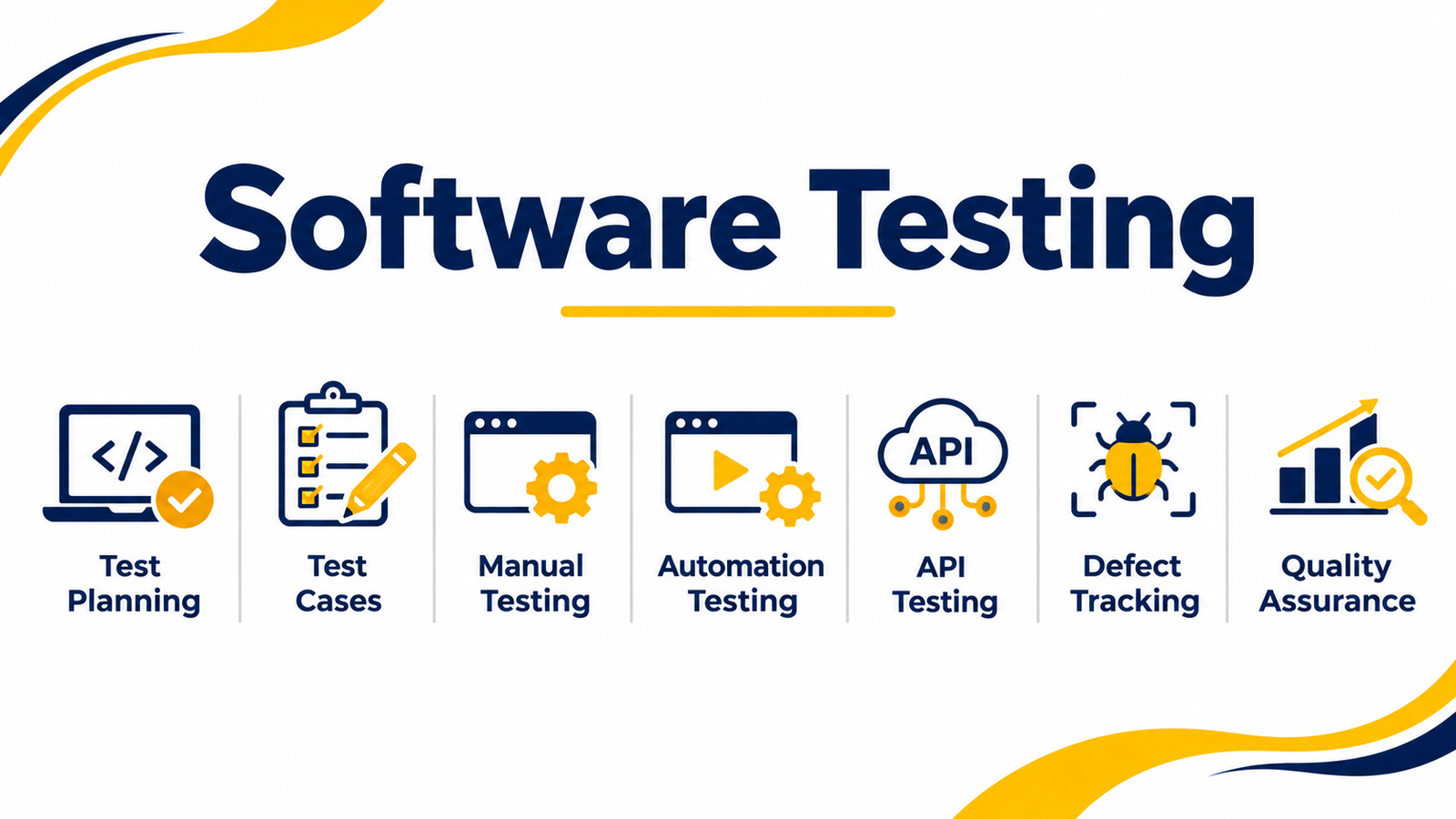
Software testing involves several important activities:
- Understanding software requirements and expected behaviour
- Designing test scenarios and test cases
- Executing functional and non-functional tests
- Identifying, documenting, and tracking defects
- Automating repeatable testing activities
- Validating APIs and application data
- Communicating software quality and release risks
These activities make software testing an important part of the software development life cycle.
Why Choose a Software Testing Course in Pune?
Pune is an established technology and education centre with IT companies, software development teams, technology service providers, and engineering talent.
For students and graduates planning careers in the IT sector, software testing provides a route into software quality assurance.
Learning software testing can help you explore various career directions, including manual QA, test automation, API testing, and software quality engineering.
Suitable for Freshers
Software testing fundamentals can be learned without previous professional experience. Beginners can start with requirements analysis, test case design, and defect reporting before moving toward programming and automation.
Multiple Career Paths
Software testing skills are relevant to companies that develop web applications, enterprise platforms, mobile applications, and digital services.
Opportunities to Develop Technical Skills
Modern testing allows professionals to work with programming languages, automation frameworks, APIs, databases, and continuous integration tools.
Long-Term Learning Opportunities
Software testers can continue developing their expertise in advanced automation, performance testing, security testing, and quality engineering.
However, employment opportunities depend on practical skills, market conditions, available vacancies, and employer requirements.
Manual Testing vs Automation Testing: Which Should You Learn?
One of the most common questions among beginners is whether to start with manual testing or automation testing.
Both are valuable, and they solve different testing problems.
What Is Manual Testing?
Manual testing involves evaluating software functionality through human observation, interaction, and judgment rather than relying entirely on automated scripts.
For example, a manual tester may examine whether a website registration form works correctly, whether error messages make sense, and whether the application behaves as expected under different conditions.
Manual testing skills include test case writing, defect reporting, requirement analysis, exploratory testing, and regression testing.
What Is Automation Testing?
Automation testing uses tools and programming scripts to execute repeatable checks and compare actual results with expected results.
For example, an automation engineer may develop a Playwright test that opens a web application, enters login credentials, submits a form, and verifies whether the user reaches the correct dashboard.
Automation is particularly useful for repetitive regression checks and continuous testing workflows.
Manual Testing vs Automation Testing Comparison
| Manual Testing | Automation Testing |
|---|---|
| Tests involve direct human execution | Tests run using tools and scripts |
| Programming is not always necessary | Programming is usually required |
| Useful for exploratory testing | Useful for repeatable regression checks |
| Emphasises test design and observation | Emphasises automation design and reliability |
| Suitable as a starting point for beginners | Builds on testing and technical fundamentals |
Which is better for beginners?
Start with manual testing concepts to understand how software should be tested. Then develop programming, API testing, and automation skills.
Learning both provides a broader foundation for modern QA roles.
Online Manual Testing Course: Build Your QA Foundation
An Online Manual Testing course can help beginners understand how software testing works before advancing to automation.
A structured manual testing learning path should include the following concepts.
Software Development Life Cycle (SDLC)
Understand how applications move through requirements gathering, planning, design, development, testing, deployment, and maintenance.
Software Testing Life Cycle (STLC)
Learn the activities involved in test planning, test analysis, test design, execution, defect reporting, and test completion.
Test Case Design Techniques
Understand techniques such as equivalence partitioning, boundary value analysis, and decision tables.
These techniques help testers select meaningful inputs and identify potential defects.
Testing Types
Learn the purpose of functional, smoke, sanity, regression, exploratory, integration, and system testing.
Defect Life Cycle
Understand how defects are reported, assigned, investigated, fixed, retested, and closed.
Agile and Scrum Fundamentals
Learn how testing activities fit within iterative software development teams.
How Educora incorporates manual testing
Educora’s AI-Powered Software Testing program begins with software testing foundations and manual QA. Learners practise writing test scenarios, designing test cases, identifying defects, and preparing testing documentation.
These fundamentals support the automation topics introduced later in the program.
Online Automation Testing Course: Learn Modern Testing Tools
An Online Automation Testing course should help learners move beyond testing theory and understand how to build reliable automated checks.
Automation requires knowledge of programming, test design, web technologies, and the tools used to execute tests.
Educora’s course focuses primarily on modern automation using Playwright with JavaScript and TypeScript.
1. JavaScript and TypeScript for Test Automation
JavaScript and TypeScript are used to write scripts, handle application data, create reusable functions, and implement automated testing logic.
Important topics include variables, functions, arrays, objects, asynchronous operations, error handling, and debugging.
2. Playwright Automation
Playwright is a browser automation framework used to test modern web applications.
Learners explore browser interaction, element locators, assertions, test execution, waits, fixtures, and automated test organisation.
They also learn techniques to improve test reliability and maintainability.
3. API Testing with Postman
API testing helps verify communication between software components.
Learners can practise sending HTTP requests, validating response codes, inspecting JSON responses, handling authentication, and organising API test collections.
4. SQL and Database Validation
SQL knowledge helps testers verify whether application data is being stored and retrieved correctly.
Essential skills include SELECT queries, joins, and basic data validation.
5. Git and GitHub Actions
Version control helps testing teams manage code changes and collaborate.
GitHub Actions introduces learners to continuous integration, where automated tests can run as part of development workflows.
6. Selenium Fundamentals
Selenium remains an important browser automation technology.
Educora’s program introduces Selenium WebDriver concepts and compares them with Playwright. The main automation learning path, however, uses Playwright with JavaScript and TypeScript.
7. Automation Framework Design
A well-structured automation framework makes test scripts easier to maintain.
Learners explore reusable helpers, Page Object Model concepts, test data management, assertions, and reporting.
Combining these technologies helps aspiring testers understand how manual QA knowledge can be applied through automated workflows.
How Is AI Changing Software Testing?
Artificial intelligence is becoming increasingly relevant to software development and quality assurance.
AI-assisted tools can help testers explore requirements, generate test ideas, draft automation code, prepare test data, and review testing documentation.
However, AI-generated results are not automatically correct.
A responsible software tester must evaluate whether suggested tests are meaningful, technically accurate, and appropriate for the application’s risks.
Examples of AI-Assisted Testing
Test Case Generation
AI can help suggest test scenarios from requirements. Testers must review these suggestions for missing conditions and incorrect assumptions.
Automation Script Assistance
AI tools can help draft automation scripts, explain errors, or suggest improvements.
Test Data Preparation
AI can support the preparation of sample inputs for selected testing scenarios, provided privacy and security requirements are respected.
Defect Analysis
AI can assist with summarising defect information and identifying patterns that require further investigation.
Testing Documentation
AI can help prepare structured reports, but technical findings must be verified.
Why Learn AI-Assisted Testing?
Understanding AI-assisted workflows can help aspiring QA professionals work more effectively with modern testing tools.
Educora’s AI-Powered Software Testing program introduces these practices alongside human verification, confidentiality, and risk-based testing principles.
The objective is to use AI as an assistant while retaining professional judgment and responsibility for testing outcomes.
AI-Powered Software Testing Course at Educora Technologies
For students seeking a structured software testing course in Pune, Educora Technologies offers an AI-Powered Software Testing Career Program combining manual QA, automation, API testing, CI workflows, and responsible AI-assisted techniques.
The program follows a six-month learning journey:
3 Months Technical Training + 3 Months Actual Company Internship
The training phase develops core software testing and automation skills. After training, learners enter a three-month company internship to apply their knowledge through supervised QA activities.
What Will You Learn?
The three-month technical training covers:
| Training Stage | Topics |
|---|---|
| Weeks 1–2 | Software testing fundamentals, SDLC, STLC, test design and manual QA |
| Weeks 3–4 | JavaScript, TypeScript, web technologies, Git and SQL |
| Weeks 5–6 | Playwright UI automation and automation framework design |
| Weeks 7–8 | API testing with Postman and API automation |
| Week 9 | GitHub Actions, continuous integration and reporting |
| Week 10 | Selenium concepts and enterprise automation overview |
| Week 11 | Responsible AI-assisted testing |
| Week 12 | Capstone assessment, portfolio and career preparation |
The program incorporates practical exercises and assessments to help learners demonstrate their understanding of testing concepts.
Projects and Practical Learning
Learners practise preparing manual test cases, documenting defects, developing Playwright automation checks, validating APIs, and preparing test reports.
The curriculum also includes an integrated QA capstone involving UI and API testing, automated execution, and quality reporting.
These activities help learners build evidence of their technical abilities.
What Happens During the 3-Month Company Internship?
A distinguishing feature of Educora’s career program is the internship phase following technical training.
The actual company internship provides an opportunity to practise software testing activities under supervision.
Month 4: QA Operations and Manual Testing
Learners work on requirement analysis, test case preparation, approved test execution, defect documentation, and QA review activities.
Month 5: Automation Testing
The focus progresses toward maintaining UI and API automation, managing test data, improving automation reliability, and understanding automated execution workflows.
Month 6: Quality Validation and Reporting
Learners work on regression testing, defect verification, quality summaries, automation results, and technical documentation.
The internship is intended to connect classroom learning with professional testing practices.
Internship arrangements, working modes, schedules, and any applicable stipend should be confirmed with Educora before enrolment.
Who Can Join the Software Testing Program?
Educora’s AI-Powered Software Testing program is designed for learners interested in starting or transitioning into software QA.
Suitable applicants include:
- BCA and MCA students or graduates
- BSc Computer Science and BSc IT students or graduates
- BE and BTech students or graduates
- Graduates from related disciplines seeking a QA career
- Career changers willing to learn programming
- Aspiring manual testers and automation QA trainees
Previous software testing experience is not required.
Learners should have basic computer knowledge, an understanding of web browsers and file management, and the willingness to learn JavaScript or TypeScript.
A personal laptop and stable internet connection are also important for practical work.
Career Opportunities After Learning Software Testing
After developing the necessary technical skills, learners may explore several entry-level roles.
Software Testing Trainee
Supports testing activities, prepares test cases, and assists with defect reporting.
Manual QA Tester
Executes test scenarios, investigates application behaviour, and documents software defects.
Automation QA Trainee
Assists with writing and maintaining automated test scripts.
Junior Test Automation Engineer
Works with automation frameworks, test execution, and reporting under appropriate supervision.
API Testing Trainee
Helps validate API functionality, response behaviour, and data accuracy.
SDET Trainee
Begins developing the combination of programming, testing, and automation skills associated with Software Development Engineer in Test roles.
A software testing course can help you prepare for such opportunities, but obtaining a position depends on your skills, interview performance, openings, and employer requirements.
How to Choose the Best Institute for Software Testing in Pune
If you are searching for the Best Institute for Software Testing, it is important to evaluate training quality rather than relying only on promotional claims.
Here are the key factors to consider.
1. Updated Curriculum
Check whether the institute teaches foundational testing concepts alongside relevant automation and API testing technologies.
2. Manual and Automation Testing Coverage
A strong learning path should explain how manual testing principles connect to automated testing practices.
3. Practical Assignments
Look for opportunities to create test cases, report defects, write scripts, and demonstrate technical understanding.
4. Modern Tools
Evaluate whether the curriculum introduces appropriate tools such as Playwright, Postman, SQL, Git, and CI technologies.
5. Internship Experience
If practical company exposure is important to you, verify whether the program provides an actual internship, how it is organised, and what activities are involved.
6. Career Preparation
Ask about technical assessments, interview exercises, portfolio preparation, and opportunities to explain your work.
7. Training Mode and Accessibility
Confirm whether the course is delivered online, in a classroom, or through a hybrid format.
The right institute should match your technical background, learning objectives, available time, and career expectations.
Why Consider Educora Technologies for Software Testing Training?
Educora Technologies offers a structured AI-Powered Software Testing program that brings together several important aspects of modern QA training.
Manual Testing Foundation: Learn test design, software testing principles, and defect management before automation.
Modern Automation Skills: Develop practical knowledge of Playwright, JavaScript, and TypeScript.
API and Database Testing: Explore Postman, REST APIs, SQL, and data validation.
AI-Assisted Testing: Learn how AI can support testing activities while maintaining accuracy and responsible practices.
Practical Assessment: Apply concepts through exercises, project demonstrations, and a capstone.
Company Internship: Progress from three months of technical training to three months of actual company internship.
Career Preparation: Develop a technical portfolio and practise explaining testing approaches.
These features make the program worth evaluating for students and graduates interested in manual QA, automation testing, and emerging AI-assisted testing practices.
Online Software Testing Course: Flexibility for Students and Professionals
For learners who cannot attend regular classroom sessions, an online software testing course can provide an accessible way to build technical skills.
Online training can be useful for students completing their degrees, graduates preparing for IT opportunities, and professionals seeking a transition into QA.
When comparing online programs, review trainer interaction, technical assignments, learning resources, practical exercises, and assessment methods.
Educora publishes batch schedules and delivery options for its career programs. Prospective learners should check the latest information before enrolling.
Frequently Asked Questions
1. Which is the best software testing course in Pune for freshers?
Freshers should consider a program covering manual testing fundamentals, test case design, defect management, programming basics, and modern automation. Educora’s AI-Powered Software Testing program includes these topics, along with practical assessments and a company internship.
2. Can I join a software testing course without coding knowledge?
Yes. Beginners can start with software testing fundamentals and manual QA. However, learning programming is important for automation testing. Educora introduces JavaScript and TypeScript during its training program.
3. Does Educora offer an online software testing course?
Educora lists virtual/online batches for its AI-Powered Software Testing program. Check the current batch schedule for upcoming dates, delivery options, and availability.
4. Does the course include manual and automation testing?
Yes. Educora’s program begins with manual testing fundamentals and progresses to Playwright automation, API testing, CI workflows, and AI-assisted testing.
5. What is the duration of Educora’s software testing course?
The complete career program lasts six months: three months of technical training followed by three months of actual company internship.
6. Is Playwright or Selenium better for beginners?
Both are established browser automation technologies. Playwright offers modern browser testing capabilities, while Selenium is widely used across many existing automation frameworks. Educora primarily teaches Playwright and introduces Selenium concepts for comparison.
7. What does an Online Automation Testing course include?
An automation testing learning path may include programming, browser automation, API testing, test frameworks, debugging, Git, and continuous integration. Educora’s program covers these areas using technologies such as Playwright, JavaScript, TypeScript, Postman, and GitHub Actions.
8. Is an Online Manual Testing course suitable for non-programmers?
Manual testing fundamentals can be learned without previous programming experience. Learners should still develop analytical thinking, technical communication, and an understanding of software behaviour.
9. Does Educora provide an internship after training?
Yes. Educora’s published AI-Powered Software Testing Career Program includes an actual three-month company internship after completion of the three-month training phase.
10. Does completing the program guarantee a job?
No. The program includes technical training, practical assessments, internship experience, and career preparation. Employment depends on available opportunities, demonstrated skills, and employer selection.
Conclusion: Build Your Software Testing Career with the Right Skills
Software testing continues to play an important role in software development, from manual quality assurance to automated testing and AI-assisted workflows.
For freshers and graduates, choosing the right software testing course in Pune means finding a learning path that builds strong fundamentals and supports practical skill development.
Manual testing helps you understand software quality, test design, and defect management. Automation testing adds programming, browser automation, API validation, and continuous integration skills. AI-assisted testing introduces additional ways to support quality assurance through carefully reviewed tools and techniques.
Educora Technologies brings these areas together through its AI-Powered Software Testing Career Program, which combines three months of technical training with three months of actual company internship.
If you are ready to explore software testing as a career, take the first step by reviewing the program curriculum and upcoming training options.
Start Your Software Testing Journey with Educora Technologies
Explore the AI-Powered Software Testing Career Program
Course Details: https://www.educoratechnologies.com/ai-powered-software-testing/
Upcoming Batches: https://www.educoratechnologies.com/batch-schedule/
Contact Educora Technologies
Phone: +91 9518776719
Email: info@educoratechnologies.com
Website: https://www.educoratechnologies.com/
Educora Technologies — Learn • Build • Transform.