Python Training in Pune: Complete Guide to Courses, Skills and Career Opportunities
Looking for Python training in Pune to start or advance your career in IT? Whether you are a student, recent graduate, working professional or career changer, Python is a valuable programming language for developing technical skills.
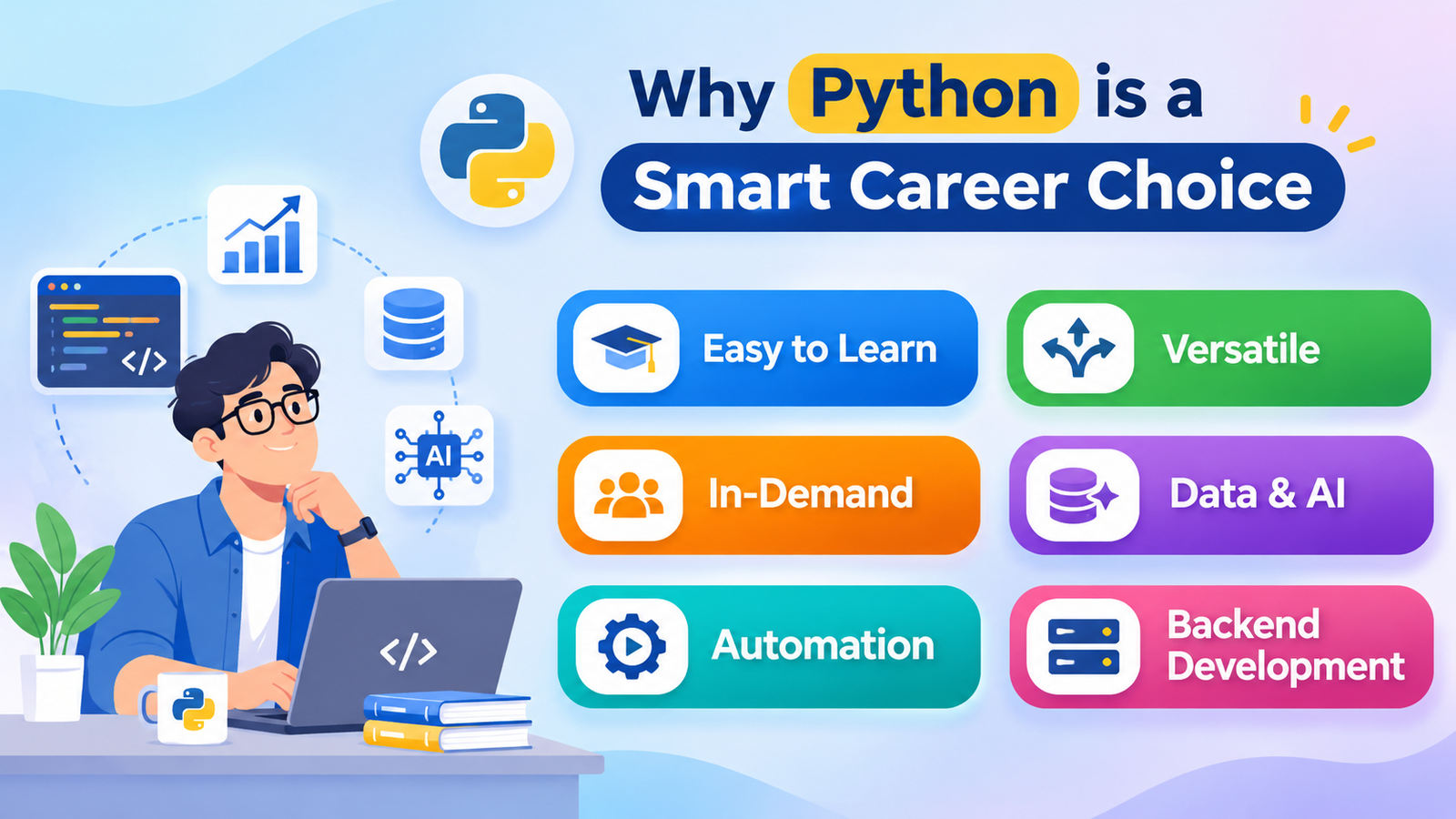
Python is used across software development, data analytics, artificial intelligence (AI), machine learning, automation and backend application development. Its readable syntax makes it approachable for beginners, while its powerful libraries support advanced technical applications.
However, learning Python is not just about memorising syntax. To develop practical programming skills, you need to understand logical thinking, data structures, functions, problem-solving and the application of Python in different technologies.
If you are searching for Python classes near me, comparing a Python institute in Pune, or exploring instructor-led training, it is important to choose a course that aligns with your learning goals.
In this guide, we will explore the skills required to learn Python, the different career paths it supports, a structured learning roadmap and how to choose the right Python training institute.
What Is Python Programming?
Python is a high-level, general-purpose programming language widely used for application development, automation, data analysis, machine learning and artificial intelligence.
It is known for its readable syntax, extensive libraries and ability to support different programming approaches.
Python allows developers to write applications, process information, automate tasks and build technical solutions efficiently.
For example, Python is used in:
- Software Development: Building applications, services and backend systems.
- Data Analytics: Cleaning, processing and analysing information.
- Artificial Intelligence: Developing and integrating AI-powered applications.
- Machine Learning: Preparing data, building models and evaluating predictions.
- Automation: Automating file processing, reports and repetitive tasks.
- Web Development: Creating backend applications and APIs.
- Software Testing: Developing automated test scripts and validation workflows.
Because Python supports multiple technologies, it provides a useful foundation for learners exploring different IT career paths.
Why Learn Python in 2026 and Beyond?
Python continues to be relevant across many areas of software engineering and data technology.
Here are some reasons why learning Python can be valuable.
1. Beginner-Friendly Programming Language
Python has a relatively clear and readable syntax, allowing beginners to focus on problem-solving and programming concepts.
Students can begin with variables, data types, conditional statements, loops and functions before progressing to more advanced topics.
2. Important for Artificial Intelligence and Machine Learning
Python supports a broad ecosystem of AI and machine learning tools.
Libraries and frameworks such as NumPy, Pandas, scikit-learn, PyTorch and TensorFlow are used for different stages of data processing, modelling and AI development.
3. Useful for Data Analytics
Python helps analysts work with structured datasets, identify patterns, perform calculations and create visualisations.
Libraries such as Pandas and Matplotlib are particularly useful for data manipulation and reporting.
4. Supports Automation
Python can automate repetitive work involving files, spreadsheets, data processing, system administration and application workflows.
5. Useful in Software and Web Development
Frameworks such as Django, Flask and FastAPI allow developers to create web applications, backend services and APIs.
6. Multiple Career Specialisations
Python skills can support further learning in software development, data science, quality assurance automation, data engineering and AI application development.
The right specialisation depends on your interests and the additional technical skills you develop.
Python Training in Pune: What Should You Learn?
Choosing the right Python training course starts with understanding the curriculum.
A structured learning path should develop fundamental programming knowledge before introducing specialised tools and technologies.
Python Programming Fundamentals
Learners should begin with the basic building blocks of Python.
Important concepts include variables, data types, operators, input and output operations, conditional statements and loops.
Understanding these concepts helps build the logical foundation required for programming.
Python Data Structures
Data structures allow programmers to store, organise and manipulate information.
Important topics include:
- Lists and tuples
- Sets and dictionaries
- String operations
- Indexing and slicing
- Data structure methods
- List comprehensions
Knowledge of data structures is important for application development, automation and data processing.
Functions and Modular Programming
Functions help developers organise code into reusable components.
Learning functions, parameters, return values, variable scope and modular programming improves code structure and maintainability.
File Handling and Exception Management
Python supports reading, writing and processing different types of files.
Learners should understand file operations and techniques for handling errors and unexpected situations.
Object-Oriented Programming
Object-oriented programming introduces concepts such as classes, objects, inheritance, encapsulation and methods.
These concepts support the development of organised and maintainable software.
Python Libraries
After building programming fundamentals, learners can progress to libraries used in specialised applications.
For data-focused training, important technologies include NumPy, Pandas and Matplotlib.
Practical Problem-Solving
Programming knowledge becomes more useful when learners can apply it.
Practical exercises involving calculations, data handling, functions, file operations and data processing can help strengthen programming skills.
Python Learning Roadmap: From Beginner to Advanced
If you are planning to learn Python from the beginning, following a structured roadmap can help you progress systematically.
| Learning Stage | Topics | Learning Objective |
|---|---|---|
| Stage 1 | Python basics, variables, operators | Understand programming fundamentals |
| Stage 2 | Conditions and loops | Develop logical thinking |
| Stage 3 | Lists, tuples, sets, dictionaries | Organise and manipulate data |
| Stage 4 | Functions, modules, file handling | Write reusable programs |
| Stage 5 | Object-oriented programming | Develop structured applications |
| Stage 6 | NumPy, Pandas, Matplotlib | Work with data |
| Stage 7 | Specialisation | Explore AI, data analytics, development or automation |
How Long Does It Take to Learn Python?
Learning duration depends on your existing knowledge, the course syllabus and the time you dedicate to practice.
Beginners can begin understanding foundational programming concepts relatively quickly, but developing confidence requires regular coding exercises.
Advanced areas such as machine learning, backend development and data engineering require additional study beyond Python fundamentals.
Rather than focusing only on course duration, evaluate what you will be able to understand and perform after completing the training.
Python Classes Near Me: How to Choose the Right Learning Option
Many learners in Pune search Google for "Python classes near me" while looking for accessible training options.
The most suitable learning format depends on your location, schedule, experience and preferred learning style.
Classroom Python Training
Classroom training may suit learners who prefer face-to-face instruction, scheduled sessions and a physical learning environment.
Before enrolling, confirm the training location, practical facilities, batch size and available timings.
Online Instructor-Led Python Training
Virtual instructor-led training allows students and professionals to attend scheduled sessions remotely.
It can be particularly useful for learners who need an organised course structure without regular travel.
Before choosing an online course, review the training format, practical exercises, instructor interaction and available technical support.
Which Training Format Is Better?
Both classroom and online learning can be effective.
The important factors are the quality of instruction, relevance of the curriculum, practical learning opportunities and the time you can dedicate to developing your skills.
For learners based in Pune, virtual training may provide an alternative to commuting while still allowing structured interaction with an instructor.
Python for Data Science vs Python for Web Development: Which Should You Choose?
Python supports multiple career paths, but the skills required for each are different.
Two commonly explored areas are data science and web development.
Python for Data Science
Data science focuses on analysing information, identifying patterns and developing data-driven solutions.
Python is used for data cleaning, statistical analysis, visualisation and machine learning.
Important technologies include:
- NumPy for numerical computing
- Pandas for data analysis
- Matplotlib for visualisation
- SQL for working with databases
- scikit-learn for machine learning
This direction can be suitable for learners interested in statistics, data analysis, business insights and AI.
Python for Web Development
Python web development focuses on creating backend applications, APIs and server-side functionality.
Important technologies include:
- Django, Flask or FastAPI
- REST APIs
- SQL databases
- Git and version control
- Authentication and application security
- Deployment fundamentals
This direction may appeal to learners interested in application development and software engineering.
Which Career Path Is Right for You?
Choose according to your interests.
If you enjoy working with datasets, statistics and analytical problems, explore data analytics or data science.
If you prefer developing applications and backend systems, consider software development.
If you enjoy scripting and streamlining repetitive activities, automation may be another direction worth exploring.
A strong Python foundation is valuable in all these areas.
How to Choose the Best Python Training Institute in Pune
Finding the best Python training institute in Pune involves more than comparing advertisements or course prices.
The right training institute should provide a learning experience suited to your present skills and future objectives.
Consider these important factors before enrolling.
1. Updated and Relevant Curriculum
Check whether the course covers the fundamentals required for your goals.
A learner interested in data analytics may benefit from NumPy, Pandas and visualisation, while a future backend developer will need web frameworks and API development.
2. Trainer Expertise
Training should involve clear explanations, practical demonstrations and opportunities to ask technical questions.
3. Practical Learning Opportunities
Programming requires hands-on practice.
Evaluate whether the course includes coding exercises, guided activities and practical problem-solving.
4. Clearly Defined Training Duration
Compare course duration with its syllabus.
A short professional training program may be suitable for focused upskilling, while a comprehensive career program usually involves a wider range of topics.
5. Learning Format
Confirm whether training is classroom-based, virtual instructor-led or self-paced.
6. Technical Prerequisites
Check whether the training is intended for complete beginners or assumes previous programming experience.
7. Transparent Fees and Policies
Review the published fees, applicable taxes, learning resources, cancellation conditions and payment terms.
8. Career Relevance
Ensure that the training supports your intended career direction.
The best Python training institute is one that provides suitable technical instruction, a relevant syllabus and learning support aligned with your goals.
Python Training at Educora Technologies, Pune
Educora Technologies provides professional IT training and technology education for students, graduates and working professionals.
For learners interested in Python programming and data-related technologies, Educora offers a Python for Machine Learning professional training course.
The program develops Python programming and data-handling foundations relevant to further learning in machine learning and analytics.
Educora Python Course Overview
| Course Information | Details |
|---|---|
| Course Name | Python for Machine Learning |
| Training Duration | 4 days / 32 hours |
| Training Mode | Virtual instructor-led |
| Batch Options | Public and one-to-one private batches |
| Prerequisites | No specific prerequisites; basic programming terminology is helpful |
| Focus Areas | Python programming, NumPy, Pandas, preprocessing and visualisation |
What Will You Learn at Educora?
The published course curriculum includes the following learning areas.
Python Programming Basics
Introduction to Python, programming environments, data types, operators and control-flow statements.
Python Collections
Lists, tuples, dictionaries, sets and their operations.
Functions and Advanced Python Concepts
File handling, strings, iterators, generators, regular expressions and object-oriented programming.
NumPy and Pandas
Introduction to numerical operations, array manipulation, DataFrames and data processing.
Data Preprocessing
Filtering datasets, transforming information, handling missing values and preparing data for analysis.
Exploratory Data Analysis
Understanding datasets using descriptive statistics and exploratory techniques.
Data Visualisation
Working with Matplotlib and understanding visual representations such as line charts, bar charts, scatter plots and heatmaps.
The currently published course concentrates on programming, data preparation and analysis foundations. Advanced machine learning model development is not explicitly included in the detailed syllabus.
Learners interested in model training should confirm the scope or explore a more specialised program.
Who Can Join Educora’s Python Training?
The course may be suitable for:
- Students interested in learning Python programming
- Fresh graduates exploring IT and data-related careers
- Professionals developing programming skills
- Data analysts interested in Python-based data processing
- Learners preparing for advanced AI and machine learning study
A willingness to practise programming is important for making progress.
Explore Educora’s Python for Machine Learning Course:
Career Opportunities After Learning Python
Python programming supports several professional directions.
However, each role requires additional skills beyond basic Python knowledge.
Python Developer
Python developers create scripts, backend applications and software services.
Additional skills may include databases, APIs, web frameworks and software engineering practices.
Data Analyst
Data analysts use SQL, statistics, visualisation tools and programming to understand information and support business decisions.
Python libraries such as Pandas can help with data cleaning and analysis.
Data Scientist
Data scientists apply programming, statistics and machine learning techniques to analyse information and develop predictive models.
Python is an important technical component of many data science workflows.
Automation Engineer
Automation engineers use scripting and technical tools to automate repetitive processes.
Python can help with report generation, file processing, system tasks and application workflows.
QA Automation Engineer
Software testing professionals may use Python to develop automated checks and testing frameworks.
These positions also require software testing concepts and knowledge of automation tools.
AI Application Developer
AI application developers work with programming, APIs and AI technologies to build intelligent application features.
Python is commonly used in AI development workflows.
Career guidance: Completing an introductory Python course does not automatically qualify someone for all these roles. The appropriate career path depends on further technical training, practical skills and employer requirements.
Python Interview Preparation: Important Topics for Freshers
If you are preparing for entry-level Python programming interviews, understanding the fundamentals is essential.
Technical interviews may test your programming logic, ability to explain concepts and approach to solving problems.
Common Python Interview Questions
1. What is Python?
Python is a high-level, general-purpose programming language used in software development, automation, data analytics and other technical fields.
2. What is the difference between a list and a tuple?
Lists are mutable collections, while tuples are immutable.
3. What is a Python dictionary?
A dictionary stores information as key-value pairs.
4. What is the difference between == and is?
== compares values for equality, while is checks whether two references point to the same object.
5. What is a function in Python?
A function is a reusable block of code that performs a defined operation.
6. What is exception handling?
Exception handling allows programs to respond to certain runtime errors using mechanisms such as try and except.
7. What is Pandas used for?
Pandas supports data manipulation and analysis, particularly with structured datasets.
8. What is NumPy?
NumPy is a Python library used for numerical computing and array operations.
How Should You Prepare?
Focus on understanding concepts instead of memorising answers.
Practise writing small programs, working with collections, solving logical problems and explaining your solutions clearly.
For analytics-oriented positions, additional practice with SQL, Pandas and data analysis can be helpful.
Why Consider Educora Technologies as Your Python Training Institute?
If you are evaluating a Python training institute in Pune, Educora Technologies offers a professional learning option with a published technical curriculum.
Structured Technical Training
The course progresses from Python fundamentals to data structures, advanced language concepts and data-related libraries.
Instructor-Led Learning
The published program uses virtual instructor-led training, allowing learners to attend scheduled sessions.
Data-Focused Curriculum
The syllabus introduces important tools such as NumPy, Pandas and Matplotlib.
Practical Programming Focus
Learners can develop their understanding of programming and data-handling concepts through technical exercises. Confirm the guided lab arrangements and included resources with the training team.
Public and Private Training Options
Educora lists public-batch and one-to-one private training options, subject to availability.
Further Professional Learning
Learners who want to develop broader skills can explore Educora’s additional programs in data analytics, data science and AI.
The appropriate training option depends on your current knowledge, learning goals and desired career direction.
Continue Your Learning: Python, Data Analytics and AI Programs
After learning Python fundamentals, you may wish to progress into more specialised areas.
Educora Technologies offers additional learning pathways for different goals.
Professional Data Analytics
Explore data analysis, SQL, Excel, Power BI, Python and AI-supported analytical workflows.
Data Science & Generative AI
Explore a longer career program covering Python, SQL, statistics, machine learning and introductory generative AI.
Mastering LangChain: Generative AI, RAG & AI Agents
For learners interested in Python-based AI application development, this program focuses on LangChain, retrieval-augmented generation, vector databases and AI agents.
These programs have different prerequisites, durations and learning outcomes. Review their individual curriculums before selecting a progression path.
Frequently Asked Questions About Python Training in Pune
1. Which is the best Python training institute in Pune?
The best Python training institute in Pune depends on your goals, budget, learning format and technical background. Compare curriculums, trainers, practical training, duration and learning support. Educora Technologies offers a Python for Machine Learning professional course covering Python foundations and data-analysis concepts.
2. Can beginners join Python training in Pune?
Yes. Beginners can start learning Python fundamentals without previous professional programming experience. Educora’s published Python course does not specify formal prerequisites, although familiarity with basic programming terminology is helpful.
3. How do I find Python classes near me?
Search for Python training providers in Pune and compare their published courses, training modes and locations. If remote learning is suitable, Educora offers virtual instructor-led Python training.
4. How long is Educora’s Python training course?
Educora’s published Python for Machine Learning course is 32 hours, described as four days of training. Calendar scheduling depends on the selected batch arrangement.
5. Does Python training include NumPy and Pandas?
Educora’s Python for Machine Learning syllabus includes NumPy, Pandas, data preprocessing, exploratory analysis and visualisation topics.
6. Is Python suitable for non-IT graduates?
Yes. Learners from non-IT backgrounds can begin with fundamental programming concepts. Advanced technical specialisations may require additional mathematics, programming or domain knowledge.
7. Is Python useful for artificial intelligence?
Yes. Python is widely used in AI and machine learning development. Advanced AI work requires additional skills beyond Python fundamentals.
8. Can I join Python training while working?
Yes. Working professionals can consider virtual instructor-led training. Confirm the available weekday or weekend schedules before enrolling.
9. Does Educora provide classroom Python training in Pune?
Educora’s published Python for Machine Learning course lists virtual instructor-led delivery. Contact Educora directly to confirm whether any classroom arrangements are available.
10. How much does Python training in Pune cost?
Python training fees depend on course duration, training mode and provider. Educora lists public and private batch fees on its course page. Check the latest published fees, GST and payment terms before enrolment.
11. Is Python enough to become a data scientist?
No. Data science also requires statistics, SQL, data preparation, visualisation, machine learning and model evaluation skills.
12. What should I learn after completing Python training?
Choose a specialisation based on your interests. You can explore backend development, automation, data analytics, data science or AI application development.
Conclusion: Start Your Python Training Journey in Pune
Python is a versatile programming language that supports opportunities across software development, automation, data analytics, machine learning and artificial intelligence.
For students, graduates and working professionals, the right Python training in Pune should provide a strong foundation in programming concepts while supporting relevant learning goals.
Whether you are comparing Python classes near me, evaluating a Python institute in Pune, or searching for the best Python training institute in Pune, focus on training quality, practical learning and curriculum relevance.
Start with Python fundamentals, develop confidence in programming and then choose a technical specialisation aligned with your interests.
Educora Technologies offers instructor-led Python for Machine Learning training covering programming foundations, data manipulation, preprocessing and visualisation.
Explore the course and contact Educora to discuss your current skills, preferred learning schedule and training requirements.
Start Learning Python with Educora Technologies
Explore Python for Machine Learning Training
Explore Professional Training Programs
Contact Educora Technologies
Phone / WhatsApp: +91 9518776719
Email: info@educoratechnologies.com
Website: https://www.educoratechnologies.com/
Educora Technologies — Learn • Build • Transform.